

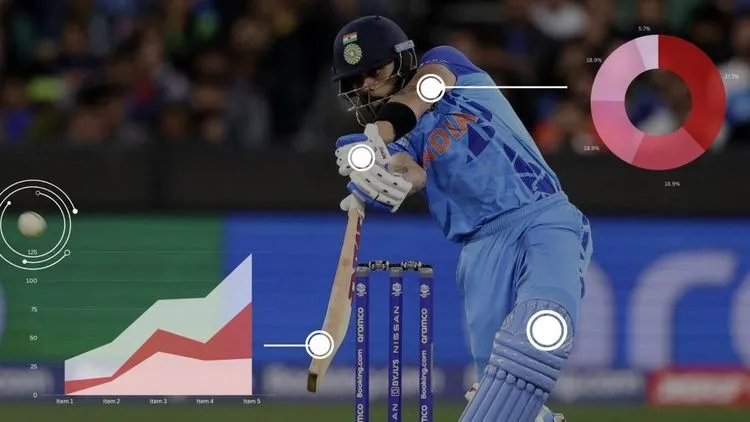
Big data in cricket has transformed the sport from a simple contest between bat and ball into a high-stakes arena of digital precision and predictive modeling. If you walk into a modern professional dressing room today, you are as likely to see a data analyst huddled over a laptop as you are to see a coach holding a stopwatch. This shift represents one of the most significant cultural evolutions in the history of the game, moving away from “gut feelings” and traditional intuition toward a landscape governed by millions of data points.
The transition began quietly in the early 2000s, but it was the explosion of global T20 leagues that truly accelerated the reliance on information. In a format where a single delivery can alter the outcome of a multi-million-dollar tournament, teams realized they could no longer leave anything to chance. Every run saved, every wicket taken at a specific juncture, and every tactical matchup is now calculated with the kind of accuracy that was once reserved for space exploration or high-frequency trading.
Imagine a scout sitting in a humid stadium in a remote part of the world, watching a teenager bowl. In the past, that scout would rely on their eyes and a notebook to judge the player’s potential. Today, that player’s every movement—their release point, the revolutions they put on the ball, their speed through the air—is being logged into a global database. This democratization of information means that talent can no longer stay hidden, and the gap between elite teams and underdogs is narrowing because of the accessibility of high-end analytics.
For the fans, this digital revolution has made the game more transparent and immersive. We no longer just watch a match; we consume it through a lens of probability and performance metrics. From “Win Predictors” to “Score Predictions,” the way we understand the narrative of a cricket match is now deeply intertwined with the output of complex algorithms. It is a fascinating time to be a follower of the sport, as we witness the marriage of century-old traditions with 21st-century technology.
How Big Data in Cricket Drives Winning Matchups
The core of a winning strategy in the modern era is the concept of “the matchup.” This is where big data in cricket becomes the primary weapon for a captain. Coaches no longer just tell a bowler to “bowl well”; they give them a surgical plan based on a batter’s historical weaknesses. If data shows that a world-class opener struggles against left-arm spin during the first six overs of a powerplay, the captain will deliberately hold back their fastest pacer in favor of a spinner, regardless of how unconventional it may seem.
These matchups are built on a foundation of historical data that spans thousands of matches across various conditions. Analysts look for patterns in how a player reacts to specific speeds, lengths, and angles. For instance, some batters might be exceptional against high-pace short balls but vulnerable to slower deliveries that grip the surface. By identifying these microscopic flaws, teams can create a “blueprint” for every opponent they face, turning the game into a high-speed version of chess.
The “entry point” of a batter is another critical metric derived from large-scale data analysis. Teams now know exactly when a player is most likely to succeed or fail based on the number of overs remaining and the current run rate. If a specialist finisher is known to struggle when they have to rebuild an innings after an early collapse, the opposition will try to keep them off the strike or bowl defensive lines that prevent them from finding their rhythm. Every decision is a calculated risk based on the probability of success.
This level of preparation also extends to the fielding side. Analysts use heat maps to show where a batter is most likely to hit the ball against different types of bowlers. This allows the captain to place fielders with inch-perfect precision. We often see a fielder moved just a few yards to their left or right just before a ball is delivered, only for the batter to hit it straight to them. To the casual observer, it looks like luck; to the analyst, it is the successful execution of a data-driven plan.
Recruitment and the Global Talent Market
Recruitment has undergone a radical transformation because of the availability of global performance data. In the past, teams would often sign players based on their reputation or their performances in international cricket. However, big data in cricket allows teams to look past the “big names” and find undervalued assets who fit a specific tactical need. This “Moneyball” approach has become the hallmark of successful franchises in leagues like the IPL, the Big Bash, and the Hundred.
A team might need a bowler who can specifically bowl at the death (the final four overs of an innings) and maintain an economy rate of under eight runs per over. By filtering through global databases, they can find a player in a domestic league in the Caribbean or a minor tournament in Asia who fits that exact profile. This has led to the rise of the “T20 specialist”—players who travel the world playing for different teams, their value dictated by their statistical output rather than their national team status.
Data also helps teams manage the “life cycle” of a player. By tracking physical metrics and performance trends, analysts can predict when a player might be entering their peak or when their skills might be starting to decline. This allows franchises to make informed decisions about who to retain and who to release during auction periods. It is a cold, calculated business where loyalty is often balanced against the hard reality of a player’s “expected contribution” to the team’s success.
Furthermore, the rise of “AI-driven scouting” means that even video footage is being analyzed by computers to identify technical flaws. If a young batter has a slight delay in their bat speed or a bowler has a mechanical issue in their delivery stride that could lead to injury, the data will highlight it. This level of forensic scouting ensures that the investment made by teams is backed by more than just a scout’s intuition; it is backed by a mountain of evidence.
Performance Tracking and Player Longevity
Beyond the tactical side of the game, data is playing a vital role in player health and longevity. Modern cricketers are elite athletes who face grueling schedules across different continents. To prevent burnout and injury, teams use wearable sensors—often tucked into a small pocket in the back of a player’s vest—to track their heart rate, distance covered, and even the “G-force” impact on their joints during a fast-bowling spell.
This information is fed into a central system that helps physios and trainers decide when a player needs a rest. This “workload management” has become a buzzword in international cricket, and while it sometimes frustrates fans who want to see their favorite stars in every game, it is essential for career longevity. Data allows teams to see when a bowler is approaching their “red zone,” where the risk of a stress fracture or a muscle tear becomes statistically high.
Biomechanics is another area where data is making a huge impact. By using high-speed cameras and 3D modeling, coaches can analyze a player’s technique in a way that was never before possible. If a bowler’s arm angle changes by even a few degrees, the data will detect it. This can be the difference between a wicket-taking delivery and a wide. For batters, tracking their “head position” and “weight transfer” through data allows them to make subtle adjustments that can improve their consistency against high-quality bowling.
The mental side of the game is also being digitized. Psychologists use data from pressure situations—such as how a player performs when ten runs are needed off the final over—to build mental profiles. Some players thrive under extreme pressure, while others perform better when the game is more stable. Understanding these psychological triggers allows coaches to manage their players more effectively, putting them in positions where they are most likely to succeed mentally and physically.
The Future Landscape of Big Data in Cricket
As we look toward the future, the integration of big data in cricket is only going to deepen. We are entering an era of “real-time analytics,” where coaches on the sidelines can receive live updates on their tablets about a bowler’s fatigue or a batter’s changing hit-zones. This allows for immediate tactical adjustments during a match, rather than waiting for the innings break to analyze what went wrong. The speed of the game is being matched by the speed of the information flowing into the dugout.
The fan experience is also set for a major upgrade through augmented reality (AR). Imagine watching a match through your smartphone or a pair of AR glasses and seeing the “projected path” of every ball or the “live strike rate” of a batter overlaid on the field in real-time. This level of immersion will turn every viewer into an analyst, allowing them to engage with the sport on a much deeper level. The “second screen” experience—where fans check stats on their phones while watching the game on TV—is becoming the primary way people consume cricket.
Artificial Intelligence will also begin to take on a more “consultative” role. Instead of just providing data, AI models will be able to suggest the “optimal bowling change” or the “best time to take a tactical timeout” based on a simulation of millions of possible match outcomes. While the final decision will always rest with the captain, the quality of the advice they receive will be unparalleled. This “man-plus-machine” approach is what will define the next decade of professional sports.
However, with all this data comes the challenge of “over-analysis.” There is a risk that the instinctive, creative side of cricket could be stifled by a fear of deviating from the data. A great player like Shane Warne or Brian Lara often did the unexpected—the statistically “wrong” thing—to win a game. The challenge for the modern era is to ensure that data remains a tool to empower the players, not a cage that limits their imagination. The human element of the game, with all its unpredictability and emotion, is still what brings people to the stadium.
The democratization of these tools will also see a rise in the quality of cricket in Associate nations. As the cost of data tracking and video analysis software continues to drop, smaller nations can use the same elite-level tools as the big powerhouses. We are already seeing the results of this in global tournaments, where smaller teams are causing major upsets by playing smarter, more data-driven cricket. The leveling of the playing field is perhaps the greatest legacy that technology will leave on the sport.
The ethics of data ownership will also become a major talking point. As teams collect more personal and physical data on their players, the question of who “owns” that data—and how it can be used in contract negotiations—will need to be addressed. It is a complex issue that will require a new set of regulations to protect the privacy and rights of the athletes. The business of cricket is becoming a business of data, and the rules of engagement are being rewritten as we speak.
At the end of the day, big data in cricket is about making sense of the chaos of a live match. It is about finding the signal in the noise. Whether it is a coach deciding on a pinch-hitter or a fan deciding on their fantasy team, the reliance on information has made the sport more intellectual and more engaging. We are no longer just guessing; we are knowing. And in a world that is increasingly driven by numbers, cricket has found a way to stay relevant by embracing the power of the byte as much as the power of the bat.
The story of a cricket match is no longer just told by the runs on the scoreboard but by the billions of bytes of data that hum beneath the surface. From the first ball of the powerplay to the final delivery of the death overs, the invisible hand of analytics is guiding every move. It is a brave new world for the gentleman’s game, one where the leather ball and the silicon chip are working in perfect harmony to create the most exciting version of the sport we have ever seen.
The evolution of the sport is a testament to its resilience. Cricket has survived for centuries because it has always been willing to adapt to the times. The age of big data in cricket is simply the latest chapter in that long and storied history. As we move forward, the challenge will be to keep the heart of the game beating while the brain of the game continues to get smarter. It is a delicate balance, but if the last decade is any indication, the sport is more than capable of handling the change.
Read also :-
tripura cricket team vs maharashtra cricket team match scorecard
railways cricket team vs assam cricket team match scorecard
saurashtra vs mumbai
bengal cricket team vs kerala cricket team match scorecard
goa cricket team vs andhra cricket team match scorecard
kerala cricket team vs bengal cricket team match scorecard
andhra cricket team vs rajasthan cricket team match scorecard