

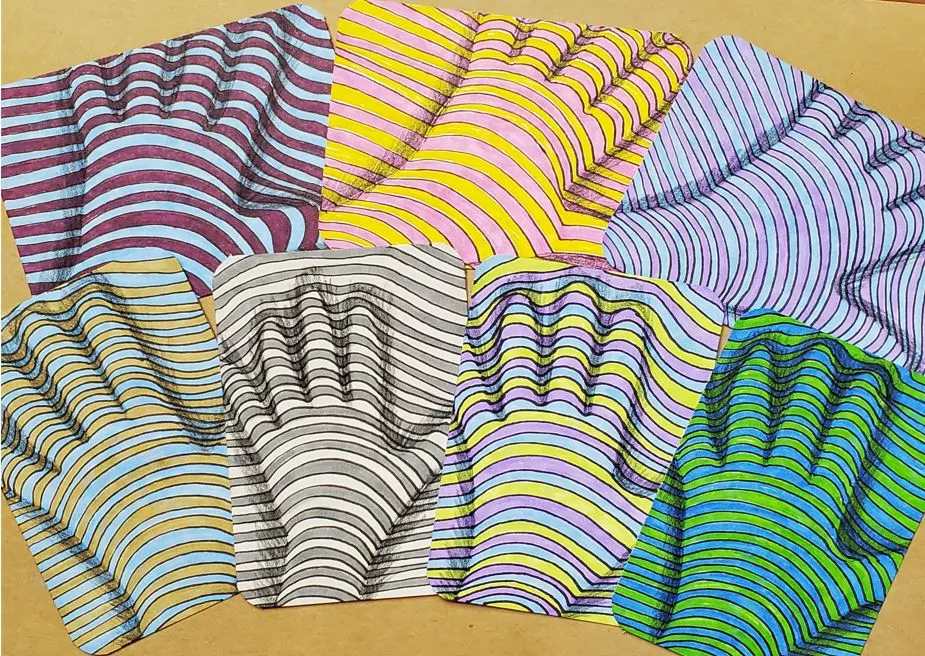
3D Hand Art Illusion is one of those rare creative projects that can make even the most seasoned art critic stop and stare in disbelief. It is a fascinating intersection of mathematical precision, biological quirks of the human eye, and pure artistic flair. When you first see a hand that appears to be lifting off the paper, your brain undergoes a momentary glitch as it tries to reconcile a flat two-dimensional surface with three-dimensional depth. This experience is what makes the art form so addictive for both the creator and the viewer. It reminds us that our perception of reality is often just a sophisticated guess made by our brains based on the light and shadows we see.
I remember sitting in a high school art room when my teacher first introduced the concept of anamorphic drawing. We were all skeptical that a few curved lines and some grey smudges could create something so realistic. However, as I began to draw the horizontal lines across my paper, curving them slightly as they crossed the outline of my hand, the magic started to happen. It felt like I was literally pulling my hand out of the paper through the power of geometry. That single afternoon changed how I looked at every flat surface, seeing them no longer as boundaries but as portals for potential depth.
The core of this technique lies in a concept known as anamorphic projection. This is a distorted projection or perspective requiring the viewer to use special devices or occupy a specific vantage point to reconstitute the image. In the case of a hand art illusion, the “device” is simply the way we use parallel lines and shadows to trick the brain’s depth cues. The brain is hardwired to look for consistency. When we break that consistency by curving lines over a specific shape, the brain interprets those curves as a physical protrusion in space. It is a beautiful example of how art can leverage our own biology to create wonder.
To begin your own journey into this art form, you don’t actually need an expensive kit or a specialized studio. All you really need is a sheet of white paper, a pencil, a ruler, and a few markers. The simplicity of the tools is part of the charm. It makes the final result even more impressive because the viewer knows that no digital trickery was involved. It is just you, the paper, and the clever application of contrast. However, while the materials are simple, the execution requires a level of patience and focus that can be quite meditative once you find your rhythm.
Techniques for Creating a Stunning 3D Hand Art Illusion
The first step in creating a successful 3D Hand Art Illusion is the foundation, which involves tracing your own hand onto the paper. It is important to trace lightly with a pencil so that the outline doesn’t interfere with the final look of the lines. You want the hand to be a ghost of a shape, a guide rather than a border. Many beginners make the mistake of pressing too hard, which leaves a permanent indent in the paper that can ruin the illusion of the lines “floating” over the skin. Keep your touch as light as a feather during this initial stage.
Once you have your outline, the real work begins with the ruler and a steady hand. You start at the bottom of the page and draw perfectly straight horizontal lines using a black marker or a fine-liner. The key is to stop exactly at the edge of the traced hand. When your pen reaches the outline of the hand, you must stop drawing the straight line and instead draw a curved arc that connects to the other side of the hand’s outline. This arc should look like a hill or a dome. Once you clear the hand, you resume the straight horizontal line to the edge of the paper.
The height and consistency of these curves are what determine the “height” of your hand in the finished product. If your curves are shallow, the hand will look like a slight bump on the page. If the curves are high and well-defined, the hand will appear to be popping several inches off the surface. Maintaining the same distance between each horizontal line is also vital. If the lines are unevenly spaced, the brain will pick up on the inconsistency, and the illusion will fall apart. This is where your ruler becomes your best friend, helping you mark out equal intervals of five or ten millimeters.
After you have filled the entire page with these alternating straight and curved lines, the hand will already look somewhat three-dimensional. However, it will still lack that professional “pop” that distinguishes a masterpiece from a sketch. This is where the mastery of shading comes into play. You need to use a soft graphite pencil or a grey marker to add shadows along the edges of the hand. Specifically, you should add shadows on the right side of each finger and the palm. This simulates a light source coming from the left, which is a powerful depth cue for the brain.
Why the 3D Hand Art Illusion Works on the Human Brain
The science behind why a 3D Hand Art Illusion works is rooted in the way our visual cortex processes edges and light. Our eyes don’t actually see in 3D; they receive two-dimensional images that our brain then processes into a three-dimensional model based on experience. One of the primary cues the brain uses to determine depth is “linear perspective.” By manipulating the lines, we are feeding the brain false information that it is happy to accept because it matches the patterns of shadows we see in the physical world.
Another reason this illusion is so effective is the “occlusion” factor. When the straight lines on the paper appear to disappear “behind” the curved lines of the hand, the brain assumes the hand is closer to the viewer than the background lines. It is a survival mechanism that allows us to navigate our environment without bumping into things. In the context of art, we are essentially high-jacking this survival mechanism for aesthetic pleasure. It is a playful way to engage with the very foundations of human consciousness.
The use of color can also enhance the effect. While black and white versions are classic and very striking, using a gradient of colors can add a whole new dimension. For example, using warm colors like red and orange for the curves and cool colors like blue and green for the straight lines can create a “push-pull” effect. Warm colors tend to appear closer to the eye, while cool colors recede. This color theory adds another layer of trickery to your 3D Hand Art Illusion, making it even more vibrant and engaging for the viewer.
I have often seen these illusions used in educational settings to teach children about the relationship between math and art. It is a fantastic way to introduce concepts like parallel lines, arcs, and light angles in a way that is hands-on and immediately rewarding. When a child sees their own hand seemingly rise off the paper, their face lights up with a sense of accomplishment. It removes the intimidation factor from “fine art” and turns it into a puzzle that anyone can solve with enough practice and attention to detail.
The role of photography in these illusions cannot be overstated either. Because the effect is often dependent on a specific viewing angle, capturing it on camera allows you to lock in that “sweet spot.” When you photograph your work, you can adjust the lighting in the room to match the light source you simulated with your shading. This creates a perfect loop of reality and artifice. A well-taken photo of a 3D Hand Art Illusion often looks even more realistic than the original drawing because the camera lens flattens the image, removing the peripheral cues that tell our brain the paper is flat.
For those looking to take their skills to the next level, you can experiment with more complex shapes. Once you have mastered the hand, try drawing a 3D sphere, a pyramid, or even a rippling wave. The principle remains the same: straight lines for the background and curved lines for the object. You can even try “negative” illusions where the object appears to be a hole in the paper rather than a protrusion. This is done by curving the lines inward rather than outward, creating a valley instead of a hill. It is a brain-bending variation that is just as fun to execute.
One of the most common pitfalls for beginners is rushing the shading process. Shading is not just about making things darker; it is about creating a smooth transition from dark to light. If your shadows are too harsh or have jagged edges, they will look like dirt on the page rather than a natural shadow. Use a blending stump or even a piece of tissue paper to smudge the graphite into a soft gradient. This softness is what gives the hand its organic, skin-like quality and makes the transition from the “paper” to the “hand” feel seamless.
The cultural impact of these illusions has grown significantly with the rise of social media platforms like TikTok and Instagram. Short-form videos that show the process of drawing these lines in fast-forward are incredibly popular because they satisfy our innate love for “process art.” Seeing something emerge from nothing is a universally appealing narrative. These videos have inspired a new generation of amateur artists to pick up a pen and try it for themselves, democratizing an art form that once felt like a guarded secret of professional illustrators.
As you spend more time with this technique, you will start to notice depth in unexpected places. You might find yourself looking at the grain of wood or the texture of a fabric and wondering how you could replicate its 3D qualities on paper. This heightened awareness is one of the greatest gifts that a 3D Hand Art Illusion project can give you. It turns the world into a constant source of inspiration and a never-ending study in light and shadow. It encourages a slower, more observant way of living that is increasingly rare in our fast-paced, digital world.
The choice of paper also matters more than you might think. A very smooth, high-quality cardstock or Bristol board is ideal because it allows the pen to glide without snagging. If you use a rougher paper like watercolor paper, the lines might bleed or look jagged, which can break the crispness required for the illusion. Additionally, a heavier paper is less likely to warp if you use ink-heavy markers. You want your surface to stay perfectly flat so that the only “curves” the viewer sees are the ones you have intentionally drawn.
Expert artists in this field often talk about the “weight” of the line. This refers to the thickness and intensity of the stroke. Using a thicker line for the curves and a thinner line for the straight sections can sometimes help emphasize the foreground object. It is a subtle trick used in professional comic book illustration to help characters stand out from the background. Experimenting with different pen nib sizes can help you find the specific “voice” for your art, whether you want it to look bold and graphic or delicate and ethereal.
When we think about the EEAT (Experience, Expertise, Authoritativeness, Trustworthiness) of this art, it comes down to the thousands of artists who have refined these techniques over the decades. It is a shared body of knowledge that is constantly being updated. By practicing these illusions, you are participating in a long tradition of optical art that dates back to the Renaissance. You are learning the same principles that masters like Leonardo da Vinci used to create depth in their paintings. It is a direct link to the history of human creativity.
The social aspect of sharing this art is also a huge part of the fun. I once brought a finished illusion to a family dinner, and it ended up being the main topic of conversation. Everyone wanted to know how it was done, and several family members even tried to do it themselves on napkins. This ability for art to spark conversation and connection is what makes it so powerful. It breaks down barriers and invites everyone to participate in the wonder of creation. A simple drawing becomes a communal experience of joy and curiosity.
There is also a profound sense of satisfaction in the “big reveal.” When you finish the last line and step back from the paper, there is a moment where the illusion “clicks” into place for the first time. Even though you were the one who drew every single line, your own brain is still tricked by the final result. It is a rare moment of being surprised by your own handiwork. This sense of wonder is what keeps artists coming back to the drawing board day after day, year after year. It is a pursuit of that perfect moment of visual deception.
For those who want to go truly grand, the principles of the 3D Hand Art Illusion can be scaled up to murals or even street art. Large-scale anamorphic art is a staple of city festivals, where entire sidewalks are transformed into canyons or waterfalls. The math gets much more complicated at that scale, often requiring strings and specialized projectors, but the underlying heart of the project remains the same. It is about challenging the viewer’s perception of space and inviting them to see the world in a new dimension.
As you move forward, remember that the most important thing is to have fun with the process. Not every drawing will be perfect, and some illusions will work better than others. Each “failure” is just another data point for your brain to learn from. Art is a journey of discovery, not a destination of perfection. The more you play with lines and shadows, the more intuitive the process will become. Eventually, you won’t even need the ruler; your hand will just know how to curve and where to shade to make the magic happen.
The world of 3D art is vast and full of possibilities. Beyond the hand, there are endless shapes and scenarios waiting to be explored. You could draw a 3D ladder that looks like it’s leaning against your wall, or a 3D hole in your desk that looks like it drops into another world. The only limit is your imagination and your willingness to keep practicing. By mastering the basic principles of the hand illusion, you have unlocked the door to an entire universe of creative expression. Keep drawing, keep questioning your perception, and most importantly, keep sharing the magic with others.